The Grace Blueprint Discipleship Center · Book by Rufus Troutman
Grace Blueprint Teaching Resource

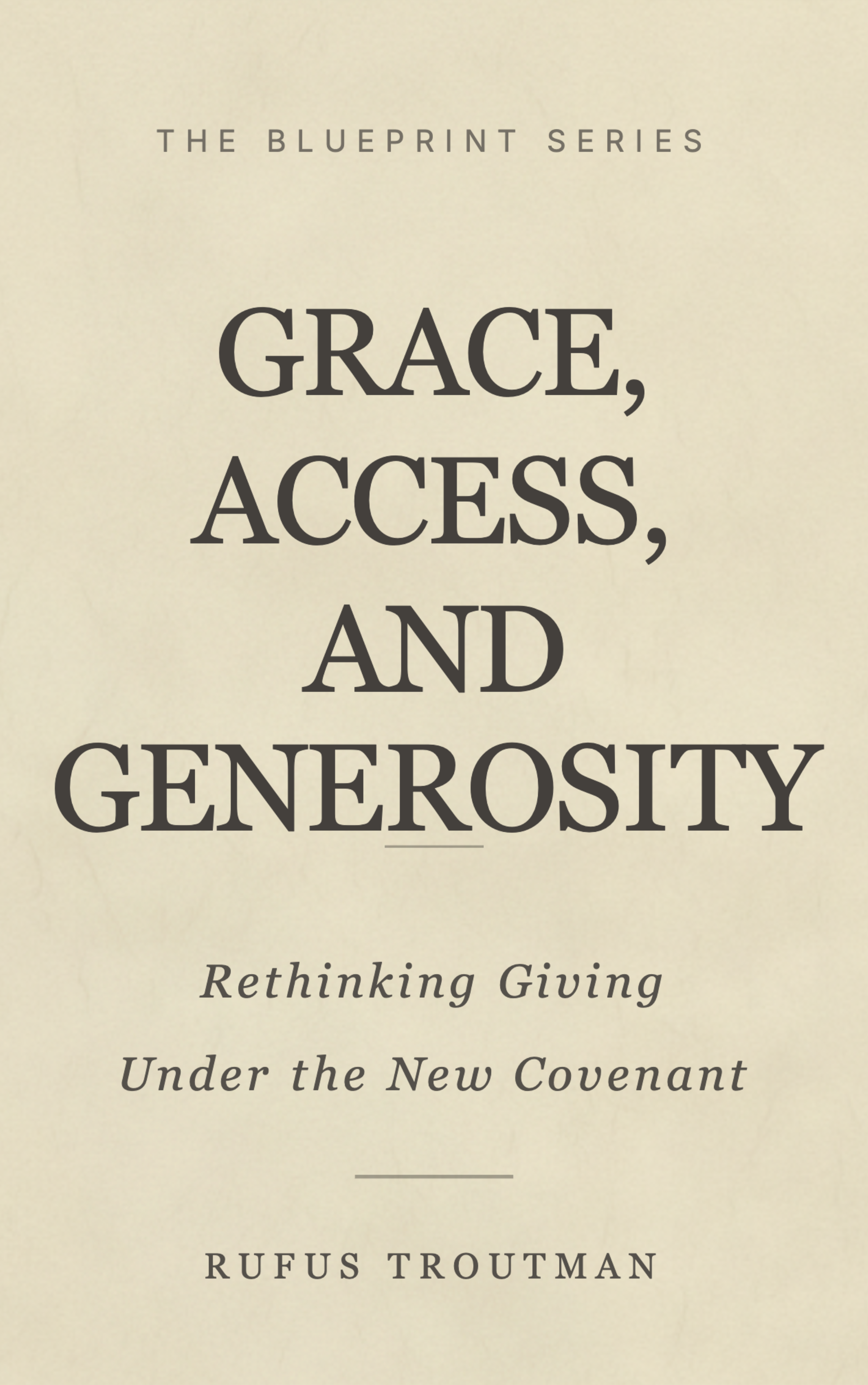
Grace, Access, and Generosity

Rethinking Giving Under the New Covenant

By Rufus Troutman

A discipleship teaching on how the New Covenant transforms our understanding of giving—moving from pressure, fear, and obligation into the joy of grace, relationship, access, and Spirit-led generosity.

No pressure. No guilt. This teaching is offered to help believers understand giving from grace, not fear.

Grace-centered theology
Hebrews 7 and New Covenant giving
Cover of Grace, Access, and Generosity by Rufus Troutman

There is no pressure to give—only an invitation to understand.

Explore More Books by Rufus Troutman
Why This Exists

A Grace Blueprint discipleship message for freedom, clarity, and relationship.

For too long, giving has often been taught in ways that produce pressure instead of freedom. Many believers have been made to feel as though access to God’s provision is unlocked by what they give, rather than understanding what has already been provided through Christ.

This message exists because people should not be manipulated, threatened, or treated as if grace is something they must purchase. Under the New Covenant, giving is not a payment for access. It is a response that flows from access already received.

You do not give to get access. You give because, in Christ, you already have it.

Part I: Historical Context

The Old Covenant & The Law

In the Old Testament, God established tithing as a command for the children of Israel. Giving 10% was not a suggestion—it was codified in the Law of Moses, operating alongside the sacrificial system and ceremonial rules.

The tithe served a specific functional purpose: it supported the Levite priests who served in the tabernacle and temple. This was a system of worship under the Old Covenant, shaped by covenantal obedience within Israel’s national life—rather than the Spirit-led generosity emphasized under the New Covenant.

“A tithe of everything from the land, whether grain from the soil or fruit from the trees, belongs to the Lord; it is holy to the Lord.”
Leviticus 27:30
“I give to the Levites all the tithes in Israel as their inheritance in return for the work they do while serving at the tent of meeting.”
Numbers 18:21

To understand giving under the New Covenant, we must first shift from seeing giving as a requirement for access to seeing it as an expression of relationship with the One who has already provided access through Christ.

Part II: Relationship & Access

Giving and Relationship Under the New Covenant

Under the Old Covenant, practices like tithing functioned within a system that helped preserve access to God through a priesthood and sacrificial structure. Giving played a role in maintaining proximity when intimacy with God was external and mediated.

Under the New Covenant, access to God is no longer maintained through systems, rituals, or financial obligations, but through union with Christ. Because access is now permanent and personal, giving no longer functions as a gatekeeper of blessing or proof of obedience.

Instead, giving becomes an expression of relationship. It flows from trust, gratitude, and participation rather than fear or requirement. Obedience under grace is not compliance to maintain favor, but alignment with a relationship already secured by grace. In this way, generosity is no longer a demand placed on believers, but a response that naturally flows from love received.

Part III: Hebrews 7

A New Priesthood Arrives

The writer of Hebrews presents a pivotal argument regarding the priesthood. When the nature of the priesthood changes, the law governing that priesthood must inherently change as well.

I

A New Order

Christ established a new priesthood—not from the tribe of Levi, but after the order of Melchizedek.

II

The Precedent

Melchizedek received a tithe from Abraham prior to the Law, demonstrating an authority that predates the Levitical system.

III

The Change

Hebrews 7:12 explicitly states that a change in priesthood necessitates a change in the law. The Levitical tithe is no longer binding.

“The former regulation is set aside because it was weak and useless (for the law made nothing perfect), and a better hope is introduced, by which we draw near to God.”
Hebrews 7:18–19
Part IV: The Cross

The Fulfillment of the Law

Jesus Fulfilled the Law

On the cross, Jesus fulfilled every requirement of the Law. Nothing was left incomplete.

Ordinances Removed

Every ordinance and regulation standing against us was nailed to the cross.

The End of the Old

The Old Covenant, including tithing laws, sacrifices, and rituals, was retired by Christ's finished work.

The New Covenant

Jesus introduced a covenant built on relationship, love, and the transforming power of the Holy Spirit.

“Christ is the culmination of the law so that there may be righteousness for everyone who believes.”
Romans 10:4

The cross did not abolish the concept of giving. Rather, it fundamentally altered the motivation. We give not out of legal obligation, but out of gratitude for the grace we have received.

Part V: Practice

The Theology of Grace Giving

Giving as Response

Under grace, giving is a voluntary response to God's goodness, mercy, and love.

Intentional & Proportional

Grace does not forbid structure. Many believers set a planned rhythm of giving in keeping with income—not as law, but as wisdom and worship.

The Cheerful Heart

God desires a cheerful giver, not one acting under compulsion.

Gratitude, Not Fear

We give because we are thankful, not because we fear curse or seek to purchase blessing.

Spirit-Led Generosity

The New Covenant standard is Spirit-led giving—responding to what God places on one’s heart.

Giving as Worship

True giving is an act of worship, demonstrating partnership in His kingdom work.

“Grace giving is not defined by amount, but by attitude. Love gives more freely, more generously, and more joyfully than law ever could.”